Sector
Agency
Role
Year
Public/Government
Government of Alberta
Research, Product Design
2026
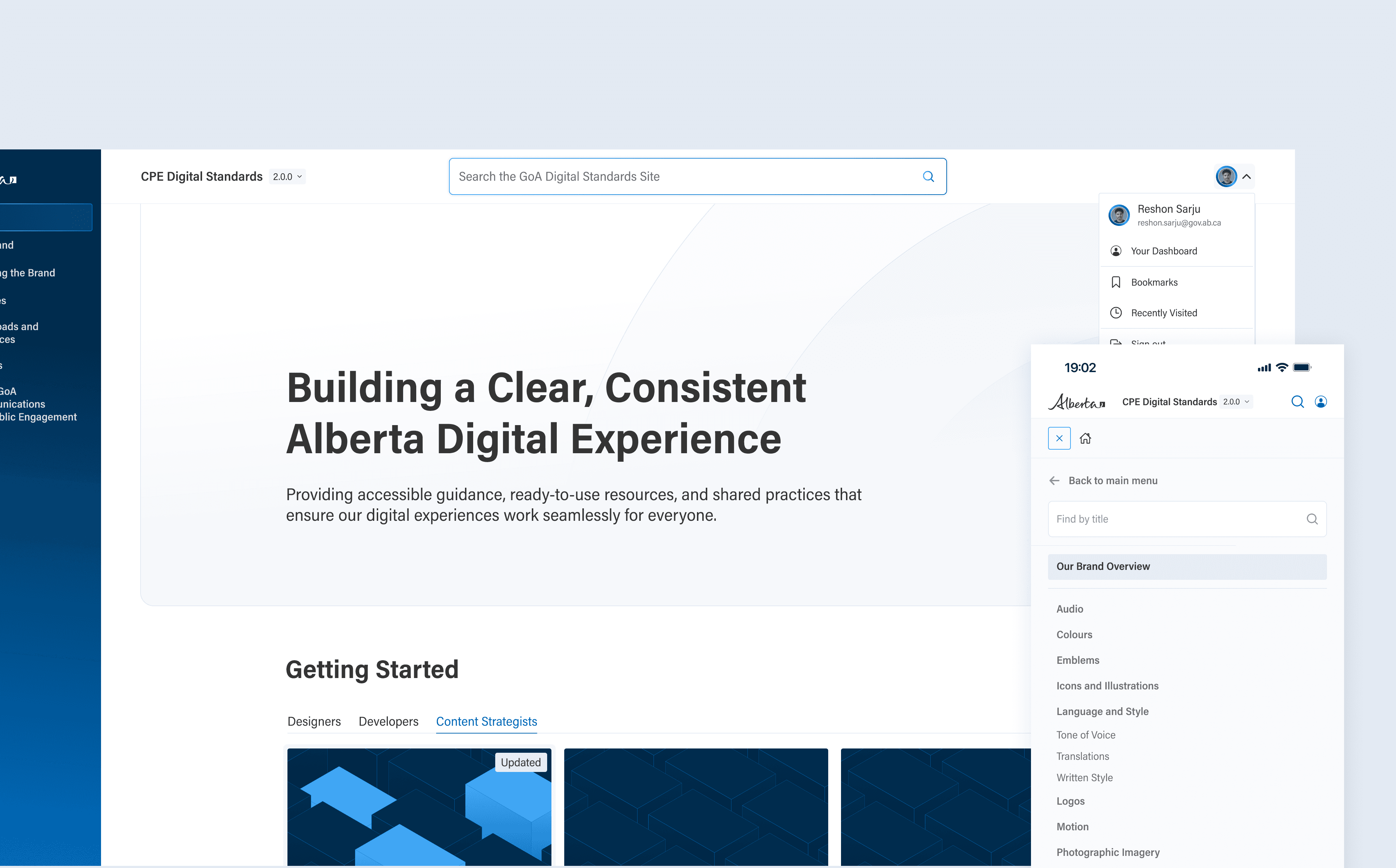
Overview
The Government of Alberta (GoA) manages dozens of digital products and teams across departments. Digital standards, design policies, and web guidance existed, but were scattered across multiple SharePoint sites, PDFs, and legacy resources.
I was tasked with defining and designing a unified source of truth where employees could easily find standards, guidelines, templates, and best practices.
Because this platform will not launch for some time, this case study highlights my process, reasoning, and validation work.
The Challenge
The Problem | Design Goal |
|---|---|
GoA employees frequently struggled to find current policies and digital standards. Resources were:
This friction led to duplicated work, outdated deliverables, and reduced alignment between teams. | Create a single, scalable platform that brings all brand and digital standards together with:
|
Discovery & Research
I conducted qualitative research to understand expectations and barriers.
Methods
1:1 stakeholder interviews
Cross-department employee interviews
Heuristic review of existing sources
Content auditing and classification
Benchmarking external government standards sites
Key Insights
People didn’t know where to start.
Most employees bookmarked multiple pages and guessed which source was most current.Design was dated and no longer felt like a relevant source of truth
The Alberta.ca website recently underwent a full redesign to improve way finding and readability. This was not reflected on the digital standards site, causing a disconnect and a lack of confidence when using.Content was dense and inconsistent.
Long PDF documents and legacy SharePoint pages created cognitive overload.Users needed simple IA, not “more tools.”
They wanted fewer places to think about, not another complex website.Search and categorization were critical.
Almost all participants said “search needs to be good” and “content should be grouped logically.”
These insights helped shape a task-based IA and a platform that prioritizes clarity.
Design & Prototyping
Using the Alberta.ca design system as a foundation, I designed a high-fidelity, end-to-end prototype that included:
Key Experience Improvements
Full redesign that utilizes and expands on the newly tested and validated design library, from the main Alberta.ca website
Clean, task-driven homepage
Mobile-first approach that prioritizes key actions and searchability
Simplified global navigation with predictable groupings
Page templates optimized for long-form standards
Content-dense layouts to reduce scrolling
Robust search patterns and filters
Cross-linked pages
Design System Expansion
Because the platform included patterns not defined in Alberta.ca’s system, following the government's design principles, I created:
new font sizing for high-density menus
adjusted spacing tokens for content-rich pages
component variations (such as grids for component galleries, tabbed documentation layouts, and resource lists)
accessibility-checked modifications to ensure consistent AA/AAA compliance
Usability Testing
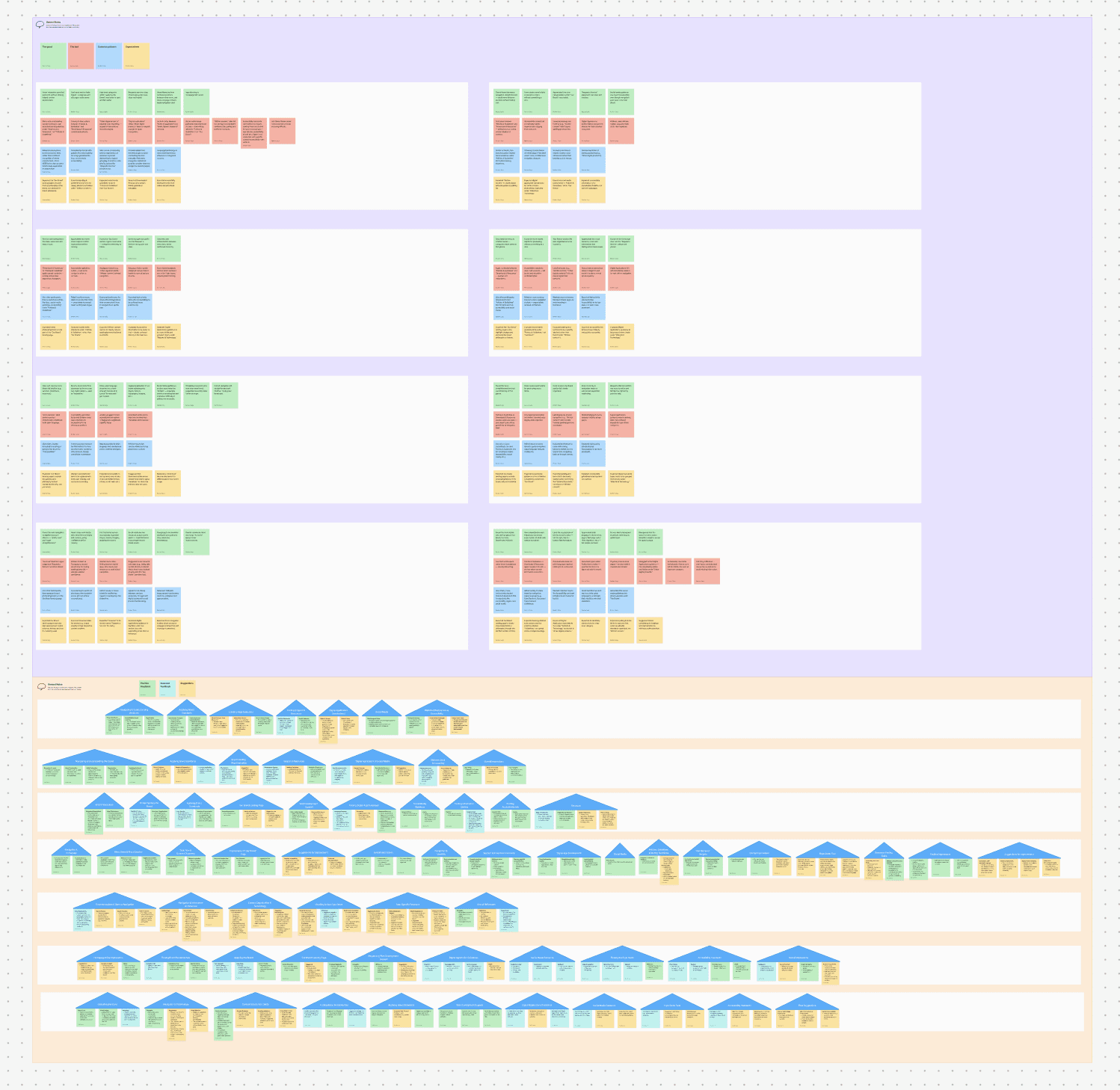
I tested both the sitemap and interactive prototype with over 30 participants across multiple departments and roles.
What We Measured | Results |
|---|---|
|
|
Insights from testing directly influenced the final IA and refined several navigation patterns.
Outcome
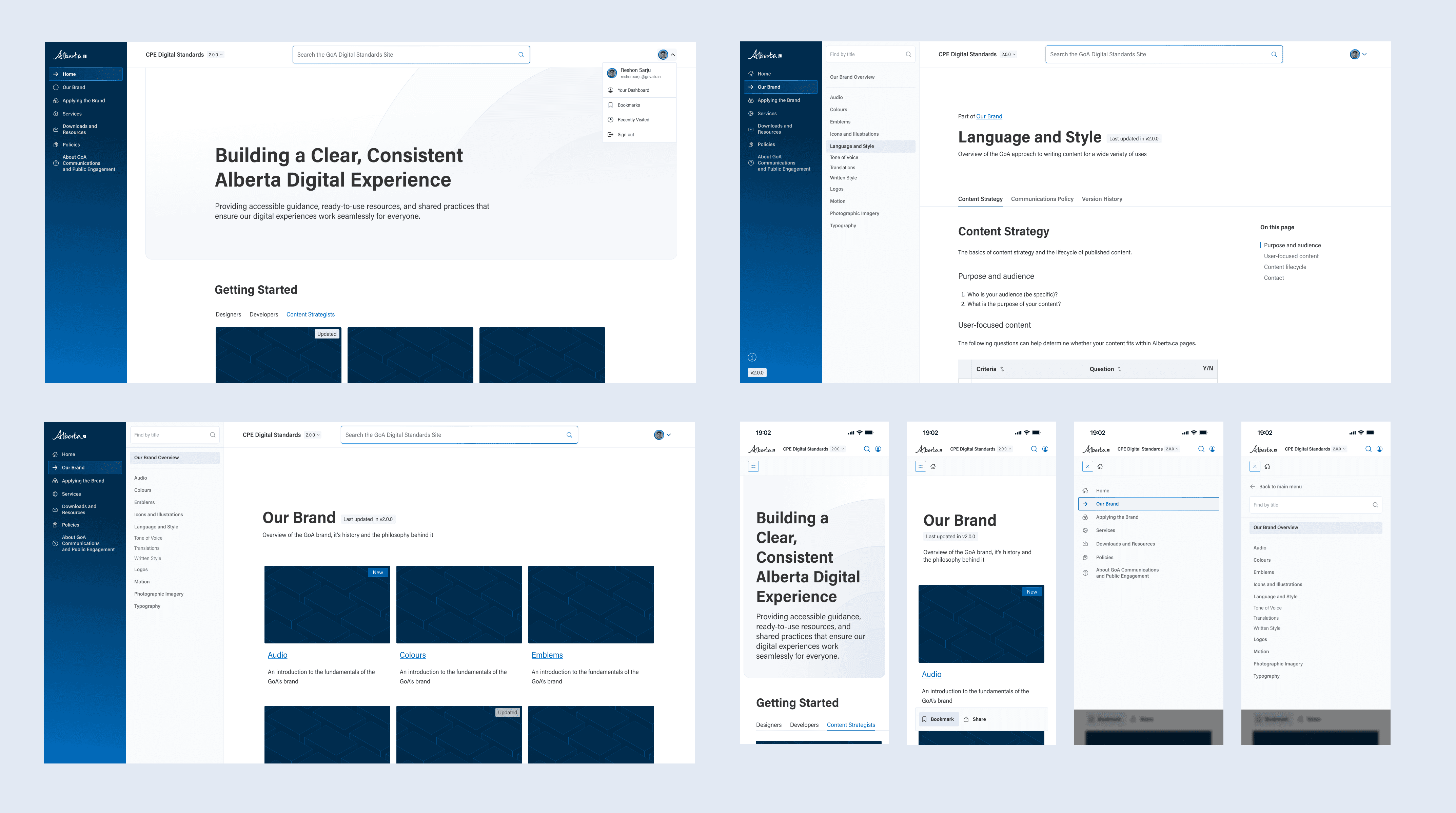
Although the platform is not yet launched (due to project timelines), the work delivered:
Deliverables
User tested and verified IA
Comprehensive high-fidelity interactive prototype
Expanded design system components
A thorough research and testing summary
Impact on the organization
Provided a clear blueprint for a long-needed unified standards platform
Established reusable design patterns for other GoA digital products
Created a scalable structure able to house new standards and policies as they evolve
Reduced internal ambiguity around where brand resources belong